Thursday, February 2, 2017

WORLD | US Senate confirms Tillerson to be Trump's secretary of state


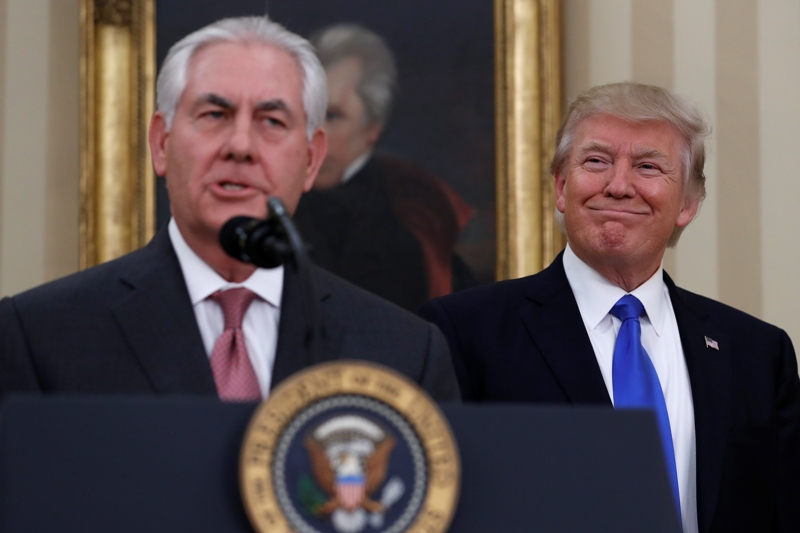
President Donald Trump smiles at Secretary of State Rex Tillerson after he was sworn in in the Oval Office of the White House in Washington, Wednesday, Feb. 1, 2017. AP/Carolyn Kaster

WASHINGTON — The Republican-controlled Senate on Wednesday confirmed Rex Tillerson to be secretary of state, a crucial member of President Donald Trump's national security team.

Tillerson was quickly sworn in during a ceremony in the Oval Office, where Trump showered him with praise.

"You understand that the job of our diplomats and the mission of the State Department is to serve the interests of the United States of America to make our nation safer, our country more prosperous and our country much more secure," the president told him. "I do believe we can achieve peace and stability in these very, very troubled times."

Senators voted 56-43 to approve the former Exxon Mobil CEO after Democrats mounted a vocal yet unsuccessful campaign to derail the bid. They said they feared his four-decade career at the energy giant meant he'd view the world only through the lens of a corporate executive and questioned whether he would confront Trump when he believes the president is wrong.

Close Ad X

But Republicans rejected the complaints and declared Tillerson highly qualified for the job. He'll have his hands full as soon as he's sworn in, grappling with many of the same geopolitical dilemmas his predecessors did. As senators cast their ballots, the Trump White House put Tehran "on notice" after the Iranian military tested a ballistic missile and allied rebels in Yemen attacked a Saudi naval vessel in the Red Sea.

Tillerson also will have to deal with any fallout stemming from Trump's executive order on immigration and travel that halts entry for 90 days to citizens from seven majority-Muslim nations.

"I am confident Rex Tillerson has the ability to be the effective leader the State Department needs," said Sen. Bob Corker, R-Tenn., chairman of the Foreign Relations Committee.

Corker cast Tillerson's experience at Exxon Mobil as a plus, saying he led a global enterprise with 75,000 employees and forged "deep relationships" with world leaders.

One of those, with Russian President Vladimir Putin, alarmed his opponents on Capitol Hill who believed he was too cozy with the Russian leader and wouldn't push back aggressively enough when Moscow acted against U.S. interests. Tillerson received an honorific — the Order of Friendship — from Putin's government in 2013.

Wednesday's vote to confirm Tillerson came exactly three weeks after a rocky confirmation hearing before the Foreign Relations Committee. Sen. Marco Rubio, R-Fla., clashed with Tillerson, bridling at his refusal to label Putin a "war criminal" and his failure to condemn human rights violations in Saudi Arabia and the Philippines in strong enough terms. He chided Tillerson over the need for "moral clarity."

But in the end, Rubio fell in line again and backed the nomination.

Rubio had unsuccessfully opposed Trump for the GOP nomination last year before coming around to support him.

Democrats pressed their case against Tillerson right up until the vote. Sen. Ben Cardin of Maryland, the top Democrat on the Foreign Relations Committee, said Tillerson is unlikely to steer Trump away from pursuing an "unstable, reckless foreign policy."

Cardin said Tillerson's "timid equivocation on American values" throughout his confirmation process led him to predict Tillerson will be a "yes man" to Trump, unable to prevent "the risky, chaotic whims of a demagogue president who is leading us on a march of folly."

Three Democrats — Joe Manchin of West Virginia, Heidi Heitkamp of North Dakota and Mark Warner of Virginia — cast their ballots for Tillerson. So did Sen. Angus King, a Maine independent. Manchin, Heitkamp and King face re-election in 2018. Trump carried West Virginia and North Dakota last year.


NATION | Duterte officials hold drug suspects, criminals not human

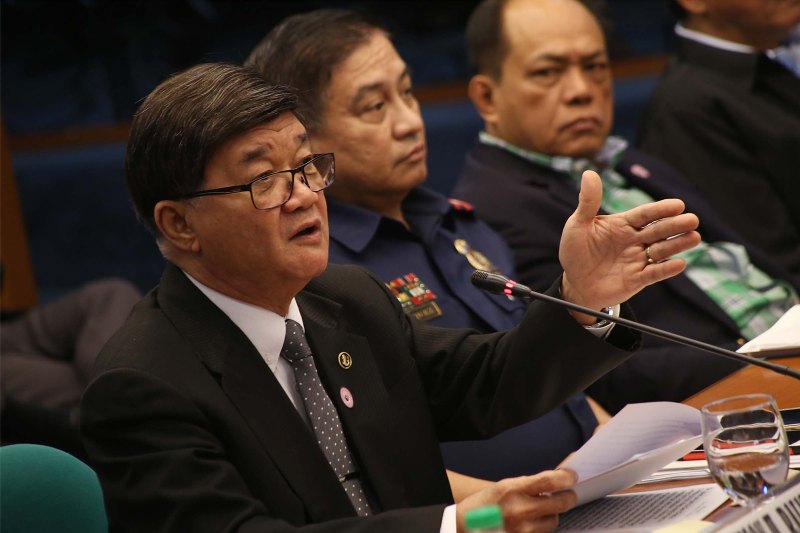
Justice Secretary Vitaliano Aguirre testifies at the Senate hearing on Tuesday (January 31) at the Senate Building in Pasay City.  PNA/Avito C. Dalan


MANILA, Philippines — Justice Secretary Vitaliano II on Wednesday dismissed concerns raised by an international human rights watchdog that drug-related killings in the country may constitute crimes against humanity under international law.

Amnesty International has raised the alarm over what it sees as the deliberate, widespread and systematic killings of alleged drug offenders which appear to be planned and organized by authorities.

The Justice secretary, however, said that he does not consider criminals part of humanity.
"The criminals, the drug lords, drug pushers, they are not humanity. They are not humanity," Aguirre said despite a pledge posted on the Department of Justice website to "provide every person equal access to justice, to faithfully safeguard constitutional rights and to ensure that no one is deprived of due process of law."

Close Ad X

Aguirre's statement also flies in the face of the Universal Declaration of Human Rights, of which the Philippines is a signatory and which holds that "all human beings are born free and equal in dignity and rights."

The same declaration holds that all people are entitled to rights and freedoms "without distinction of any kind, such as race, colour, sex, language, religion, political or other opinion, national or social origin, property, birth or other status", including being suspected of involvement in a crime.

Aguirre's statement, one that has also been expressed by other government officials, also contradicts the 1987 Constitution that he swore to uphold and that declares that the state "values the dignity of every human person and guarantees full respect for human rights."

The same constitution, ratified 30 years ago on Thursday, also holds that "no person shall be deprived of life, liberty, or property without due process of law, nor shall any person be denied the equal protection of the laws."

Aguirre not alone

Aguirre is not the only member of the Duterte administration who has expressed disdain for the rights of suspects, whom they view as less than human. House Speaker Pantaleon Alvarez on Wednesday said that he personally has no problem with vigilante killings and that he would prefer a shoot-to-kill order on criminals.

In July 2016, Solicitor General Jose Calida, the country's top lawyer, said in reaction to the deaths of people suspected of being involved in drugs that: "To me, that is not enough."

President Rodrigo Duterte has also justified the killings of drug suspects in the country saying they are not human.

"Crime against humanity? In the first place, I’d like to be frank with you: Are they humans? What is your definition of a human being?" Duterte told soldiers while visiting an army camp in August last year.

"Human rights? Use it properly in the right context if you have the brains," the president said.

'Killings not state-sanctioned'

The international watchdog called on Duterte to order an immediate halt to all extrajudicial executions in the country.

The Palace has said that there are no extrajudicial killings in the country but stressed Wednesday that "the extrajudicial deaths are not state-sanctioned."

Presidential spokesperson Ernesto Abella also said that a Senate investigation determined "there is no state-sponsored policy of extrajudicial deaths and that there is relentless effort on the part of the PNP (Philippine National Police) to carry out the campaign properly and within legal processes."
AI Crisis Response Director Tirana Hassan said that the Philippine should move away from lawlessness and lethal violence. She also asked the government to reorient its drugs policies based on the protection of health and human rights.

"We are also calling on the Philippines Department of Justice to investigate and prosecute anyone involved in these killings, regardless of their rank or status in the police or government," Hassan said.
Hassan warned that the international community may turn to the prosecutor of the International Criminal Court to carry out a preliminary investigation into the killings, including the involvement of state authorities. ​— with Jonathan de Santos/Philstar


Wednesday, February 1, 2017

REGION | NPA to end ceasefire

head04


The five-month-ceasefire between the government and the National Democratic Front (NDF) is in danger of ending due to a series of encounters between the New people’s Army (NPA) and the Armed Forces of the Philippines (AFP).

On Wednesday morning, the NPA is set to release an announcement, a week after they threatened to withdraw from the ceasefire.

Jorge ‘Ka Oris’ Madlos, NPA spokesperson, will have a press conference this morning that might strengthen speculations that the group will return to the battlefield.

Government Peace Negotiator Hernani Braganza is hopeful that the NPA will not withdraw from the existing ceasefire until the next talks of both parties in The Netherlands on February 22.

Braganza said the two parties habe an agreement in the next talks that they will discuss the possibility of a bilateral agreement. - Kristine Dela Cruz/RHNews

ENTERTAINMENT | Facebook to develop app for television set-top boxes – WSJ

A 3D printed Facebook logo is seen in front of a displayed cyber code in this illustration taken March 22, 2016. REUTERS/Dado Ruvic/Illustration

Facebook Inc  is creating an app for television set-top boxes, including Apple Inc’s  Apple TV, the Wall Street Journal reported, citing people familiar with the matter.

The world’s biggest online social network is also in discussions with media companies to license long-form, TV-quality programming, the Journal reported on Tuesday.

Facebook declined to comment.

An app for set-top boxes would bring Facebook closer to live video and video advertisements.
Getting advertisers to buy more video ads is key to Facebook’s continued revenue growth as such ads fetch higher rates from advertisers than text or photo-based ads.

Live video is also becoming a highly competitive feature on social platforms, with companies competing to stream major sports events and exclusive video components from high-profile events such as the Oscar and Grammy awards shows.

In April, Facebook expanded its live video product, Facebook Live – a potential threat to broadcast television, giving it prominent placement on its app and rolling out features to make it easier for users to search and comment in real time.

(Reporting by Arunima Banerjee in Bengaluru; Editing by Savio D’Souza)


WORLD | Some nations affected by U.S. immigration order may stay on list

People gather to protest against U.S. President Donald Trump's executive order travel ban at Los Angeles International Airport (LAX), California, U.S. January 31, 2017. REUTERS/Monica Almeida
People gather to protest against U.S. President Donald Trump’s executive order travel ban at Los Angeles International Airport (LAX), California, U.S. January 31, 2017. REUTERS/Monica Almeida | By Julia Edwards Ainsley


WASHINGTON  – Nationals from seven Muslim-majority countries temporarily barred from the United States by President Donald Trump’s executive order may be blocked indefinitely, and others might be added to the list, Homeland Security Secretary John Kelly said on Tuesday.

Under the order released on Friday, travellers from Iran, Iraq, Libya, Somalia, Sudan, Syria and Yemen may not enter the country for at least 90 days while Kelly and others determine whether there is enough information available to screen them.

“Some of those countries that are currently on the list may not be taken off the list anytime soon, if they are countries that are in various states of collapse, as an example,” Kelly told a press conference.
Kelly said others may be added if it is determined they “could tighten up their procedures” to ensure more secure vetting.

Several lawsuits have been filed blocking portions of the order, which drew harsh criticism from some of Trump’s fellow Republicans, Democrats, human rights organizations and some Western U.S. allies.

Vice President Mike Pence was closely questioned about the order by Republican senators during their weekly caucus lunch.

“Obviously what happened Friday, they have to understand, was not well done,” Republican Senator Bob Corker told reporters. “… There are a lot of issues here that I don’t think were well thought through.”

Confusion mounted during the weekend as U.S. Customs and Border Protection, a division of the Department of Homeland Security, rushed to brief airlines and customs agents about how to implement Trump’s order. The executive action was not explicit about how to handle a wide range of people trying to enter the United States, including permanent residents, students and even Iraqi pilots training to protect U.S. troops.

Acting Customs and Border Protection Commissioner Kevin McAleenan told reporters he had briefed appropriate parties “within two hours” of the order.

Kelly said he knew the order was coming and “had people involved in the general drafting of it.”
But a Department of Homeland Security official, speaking on the condition of anonymity, said Customs and Border Protection officers had no advance notice of the order or how to respond.

ANSWERING QUESTIONS

Some issues were addressed on Tuesday.

Kelly said people from the seven targeted nations who hold dual citizenship would be allowed to enter the United States on the passport of a non-restricted nation, which had been uncertain.
The executive order also stopped the resettlement of refugees for 120 days. But the administration granted waivers to 872 “in transit” who will be arriving this week.

Kelly came to the U.S. Capitol later on Tuesday to brief congressional leaders and the heads of national security committees about the order. He was peppered with questions from both Republicans and Democrats concerned about the lack of planning.

Senator Claire McCaskill, the ranking Democrat on the Senate Homeland Security Committee, said Kelly made clear the White House is happy with the order, and that the administration had not wanted to wait to address details about its implementation.

“It was pretty clear that the president wanted this executive order put in place, and he wanted it implemented immediately. And it’s not going anywhere,” she told reporters.

Since the order, 721 travellers with visas from the seven countries were denied boarding U.S.-bound flights, according to McAleenan. The department has also processed 1,060 waivers for legal permanent residents, such as green card holders.

Kelly said immigration and customs officials were in compliance with court orders and no agent knowingly or intentionally violated them.

The Trump administration also sought to clarify on Tuesday that citizens of U.S. ally Israel who were born in Arab countries would be allowed into the United States. The U.S. Embassy in Tel Aviv said a valid U.S. visa in an Israeli passport would still be valid even if the passport holder was born in one of the seven countries.

(Reporting by Julia Edwards Ainsley, Patricia Zengerle and Doina Chiacu; Additional reporting by Ayesha Rascoe and Matt Spetalnick; Editing by James Dalgleish)


NATION | Korean victim of ‘police scalawag’ returns to PHL-Dela Rosa

PNP Chief Dir.Gen. Ronald Dela Rosa (photo by DZRH Raymund Dadpaas)


MANILA - Philippine National Police (PNP) Chief Director-General Ronald Dela Rosa confirmed that one of the three Korean victims extorted by some police assigned in Angeles City Police Office Station-5 in Pampanga is back in the country.

Dela Rosa said that PRO-3 Regional Police Director C/Supt. Aaron Aquino confirmed of the said news.

The decision of the victim aims to formally file a complaint against the cops who allegedly extorted money from him.

The Korean is identified as Lee Ki Hoon, a first time tourist in the country who only visited to play golf but was extorted by the suspects.

The PNP chief is hopeful that the Korean’s return will clarify the incident and file charges against the suspects who are members of the PNP.


NATION | Philippines drugs war killings systematic, planned – Amnesty

Maria Isabelita Espinosa, mother of teenager Sonny Espinosa, who according to the police is one of the seven people shot dead by suspected vigilantes at a house storing illegal narcotics, cries during her son’s funeral in Caloocan city, Metro Manila, Philippines January 8, 2017. REUTERS/Romeo Ranoco

MANILA  – A wave of drugs-related killings in the Philippines appears to be “systematic, planned and organised” by authorities and could constitute crimes against humanity, according to an Amnesty International report released on Wednesday.

Amnesty said its investigation into President Rodrigo Duterte’s war on drugs was based on 59 drug-related killings in 20 cities and towns. The agency said it concluded most appeared to be extra-judicial killings, and police accounts of shootouts and deaths during operations were “startlingly similar”, and often far different to witness testimony.

The release of the report comes amid uncertainty over the anti-drugs crackdown and a government suspension on Monday of all police operations due to rampant corruption. The Philippine Drugs Enforcement Agency (PDEA) has now been given the lead role in the campaign.

Duterte made the decision after a security meeting on Sunday triggered by the kidnap and killing of a South Korean businessmen by drugs squad police. He said the incident, which took place at the headquarters of the Philippine National Police (PNP), had embarrassed the country and dented the image of the police.

Amnesty said the vast majority of the killings it investigated “appear to have been extra-judicial killings – unlawful and deliberate killings carried out by government order or with its complicity or acquiescence”.

“The Duterte administration’s relentless pressure on the police to deliver results in anti-drug operations has helped encourage these abusive practices,” the report said.

The Presidential Communications Office did not immediately respond to a Reuters request for comment on Amnesty’s findings.

The government has denied sponsoring extra-judicial killings, or police collaboration with assassins.
The investigation by the London-based advocacy group was carried out mainly in November and December and was completed in January. It said it interviewed 110 people and included witness accounts of victims being shot dead despite having shouted they would surrender.

It said it also found “strong evidence” of links between the authorities and unknown gunmen, as well as connections between cursory and speculative drugs “watch lists” created by local officials, and the people killed by police.

Amnesty’s report included numerous references to a series of Reuters stories and investigations into the war on drugs in the Philippines.

The latest police data shows 7,669 people have been killed since Duterte unleashed his war on drugs seven months ago, 2,555 in police operations, which the PNP says were all in self-defence. The other deaths are classified as investigated, or under investigation.

Human rights groups believe most of those are drugs-related, carried out by vigilantes or hit men.
Amnesty’s top recommendation to Duterte was to “immediately order an end to all police operations involving unnecessary or excessive use of force”, especially lethal force.

It said police should suspend officers suspected of unlawful killings, planting evidence or involvement with hit men, and thoroughly investigate paid killings.

It recommended Duterte appoint a new independent head of police internal affairs and the justice ministry prevent intimidation of witnesses and victims and set up a task force to prosecute extrajudicial killings.

“The Philippine government needs to urgently adopt a different approach to drugs and criminality,” it said.

“The impunity that currently reigns has facilitated killing on a massive scale, hitting the poorest and most marginalised segments of the population in particular.”

(Reporting by Martin Petty; Editing by Raju Gopalakrishnan)